Docket Report: FS Credit Opportunities v. Saba Capital
January 14, 2026 • jed
[I’m a little behind on the docket due to the holidays and a few competing deadlines. As I catch up, many of the docket entries will be more abbreviated.]
This is a nice case at foundation about trends in statutory interpretation and how they interface with implied private rights of action. Congress can enforce its laws in a variety of ways. Typically, it does so through the executive branch. However, it also can and not uncommonly does give rights to private parties to enforce statutory rights. But how explicit must Congress be when it gives such rights of action to private parties?
For a long time, courts approached that question holistically—looking broadly to the aims of Congress, evidence in the statute, and so on. More recently, the Court has taken a narrower view towards what counts as evidence of statutory meaning, focusing (far more) exclusively on the text of the statute. This is part of a shift to more formalist methods of legal reasoning that I study with co-authors (e.g., link, link). An implication of this move to the text is that implied rights of action should be very difficult to find in statutes. And that has been the trend: the Court has been more skeptical of implied rights of action.
Here, the statute in question—the Investment Company Act (ICA)—creates standards to protect investors from various forms of misconduct by investment companies. At issue is whether private parties can enforce those standards, or if the sole channel of enforcement is the SEC. Most relevant, the statute provides: “[t]o the extent that a contract [that violates the ICA] has been performed, a court may not deny rescission at the instance of any party unless such court finds that under the circumstances the denial of rescission would produce a more equitable result than its grant and would not be inconsistent with the purposes of [the ICA].” Why would Congress use the language “at the instance of any party,” respondents observe, if they did not create a private right of action? There is also a 1979 precedent that read a private right of action in a closely related statute. The petitioners, on the other hand, point out that this provision does not create a right itself, speaks to courts not parties, and that parties might be positioned to seek a rescission even if they did not have a private right of action.
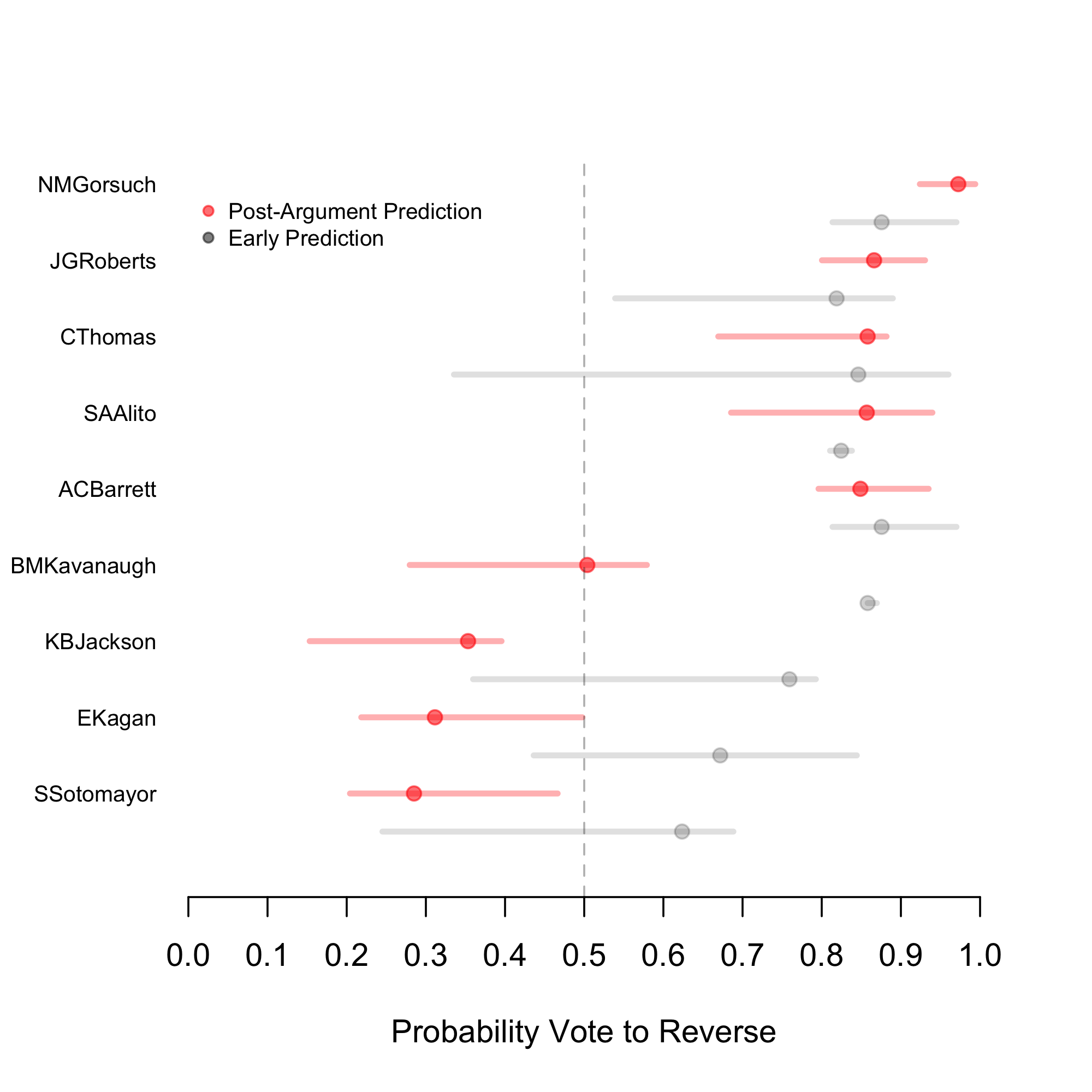
Despite a somewhat mixed argument, the model predicts the Court will reverse, denying the private right of action. The result could easily be 5-4, though, with the model suggesting Kavanaugh the most likely to join the liberals.
vote predictions