The Court recently heard argument in two transgender cases. They differ in several respects, but the basic set up is the same: a state law prevents transgender girls/women from competing on girls'/women’s sport teams. As they reach the Court, the transgender women challenge the state laws on equal protection grounds, and, in one case, based on Title IX. The plaintiffs (challengers) won in the Courts of Appeals. The states now seek to reverse those lower court decisions.
Both cases rest on claims of unconstitutional sex discrimination—the West Virginia case also presents a statutory issue of sex discrimination under Title IX. These are another of the term’s blockbuster cases, and aside from their cultural significance, they also raise interesting questions of legal interpretation.
On the statutory side, the closest the Court came to this issue was in Bostock, when they held that Title VII’s bar on discriminating “because of sex” reaches gay or transgender individuals. Gorsuch wrote the opinion for the Court, and the logic was straightforward. If someone (say) is married to a man, to fire that person if they are a man, but not if they are a woman, is to make sex a but for cause of termination. That is discrimination “because of” sex.
That same basic argument is now advanced in the context of Title IX. Though similar in many ways, the present case is more difficult because Title IX is understood to recognize distinctions based on sex, with regs issued shortly after passage saying that recipients of funds “may operate … separate teams for members of each sex.” And BPJ, the plaintiff in the West Virginia case, does not challenge the status of separate teams for men and women. Thus, if a cisgender boy were denied participation in a girls’ sports team, the denial would uncontroversially be because of their sex, but that would not be regarded as discrimination under Title IX. BPJ acknowledges the permissibility of sex segregated teams, but argues that their individual exclusion is discriminatory under the statute.
The Court has not yet cleanly articulated how transgender status intersects with equal protection jurisprudence. There are two basic channels to be considered. First, arguably the more straightforward path is to argue that the discrimination is sex discrimination, requires heightened scrutiny, and fails that standard. Second, they could say that the laws discriminate on the basis of transgender status, and that form of discrimination separately requires heightened scrutiny, and that the laws fail that standard.
Part of the strategy that the justices will be thinking through is how their votes may change, not just the disposition of the cases, but also the reasoning of their holdings. Someone like Justice Kagan may join a conservative coalition because she thinks that doing so will result in a narrower holding.
Here, the narrowest possible holding that a conservative majority might join would likely focus on the sports context. With respect to equal protection, they would say that the laws trigger heightened scrutiny due to sex discrimination, but that they pass scrutiny due to the sports context. This would leave open the possibility of future challenges by transgender individuals outside the sports context. With respect to Title IX, they again would focus on the allowances in the statute (Javits amendment) and earlier interpretations for sports-based sex distinctions. This would likewise leave open the possibility of future Title IX challenges outside the sports context. It is hard to forecast how those coalitional dynamics will play out.
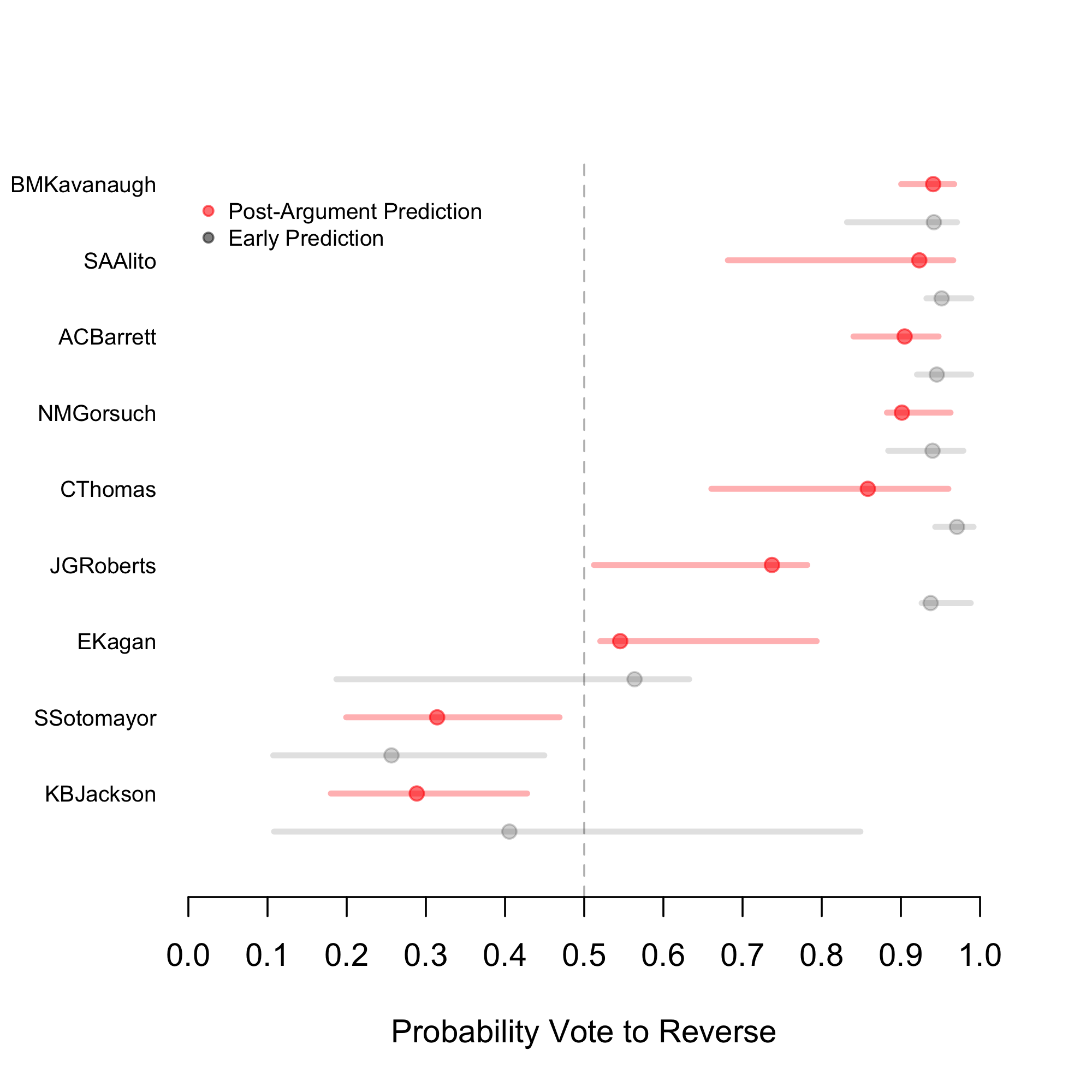
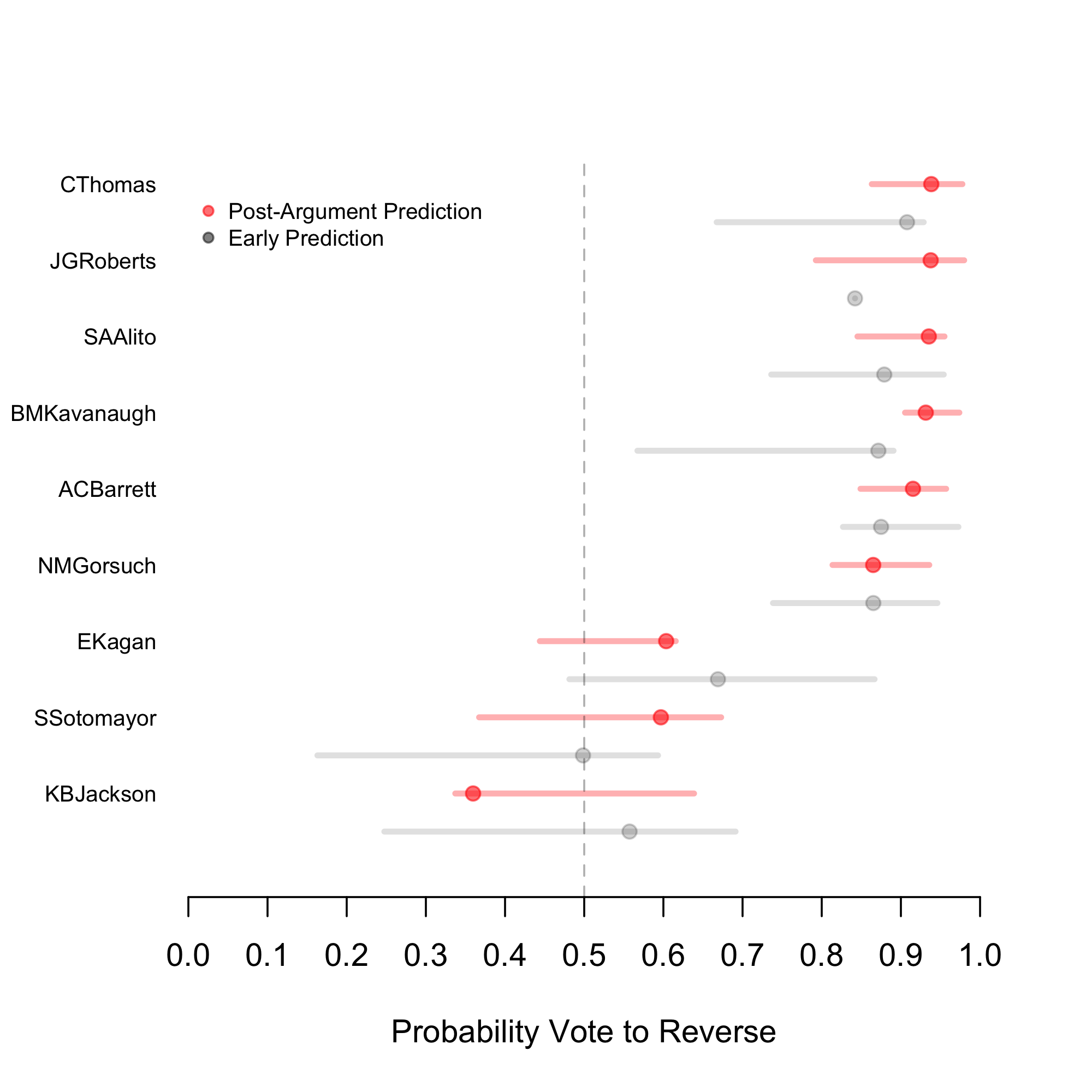
Not surprisingly, the model predicts the Court will reverse the lower courts, thus allowing the state laws to stand. (Hecox’s effort to argue the case is moot suggests they see the same outcome.) The model predicts that Kagan will join the conservative majority in both cases, and that Sotomayor will join it in Hecox. Kagan’s vote might be slightly more uncertain in the BPJ case because of the added complexity of the statutory claim. Personally, I’m a little skeptical that either case will be anything other than a conventional 6-3 vote.
Hecox vote predictionsBPJ vote predictions