Suppose a prisoner escapes and is on the run for two years. They’re caught and put back in prison. Do they receive credit towards their original sentence for the time they spent on the run? The answer to that is, no. The fugitive tolling doctrine prevents that time on the run from counting as time served.
Okay, so what if the individual “escapes” from supervised release, instead of from prison? Does the time out of compliance with supervised release count? That’s the core question in Rico v. United States. After being released from prison for selling drugs, Rico was subject to a period of supervised release, which was part of her sentence. She was required to check in with a probation officer, participate in drug treatment, and avoid using drugs or committing other crimes for a period. During the period of supervised release, she began using drugs again and moved without informing her probation officer.
Does she receive credit for the time after she left supervision? The answer to the question matters because it changes how additional crimes committed after her release from prison would be processed.
The lower court (Ninth Circuit) applied the fugitive tolling doctrine to supervised release, so that the time spent away from her probation officer did not count. She appealed. She argues there is no textual basis for tolling in the supervised release legislation (Sentencing Reform Act), whereas the government relies on common law principles.
During argument, justices seemed skeptical of the government position. For example, Roberts suggested the government was trying to “double count” the time during which she absconded—once for the time away from supervision, and once for the violations of the conditions of her supervised release. Alito also suggested little turned on whether the period was tolled or not—either way, the sentencing judge could take account of behavior before and after she absconded from supervised release.
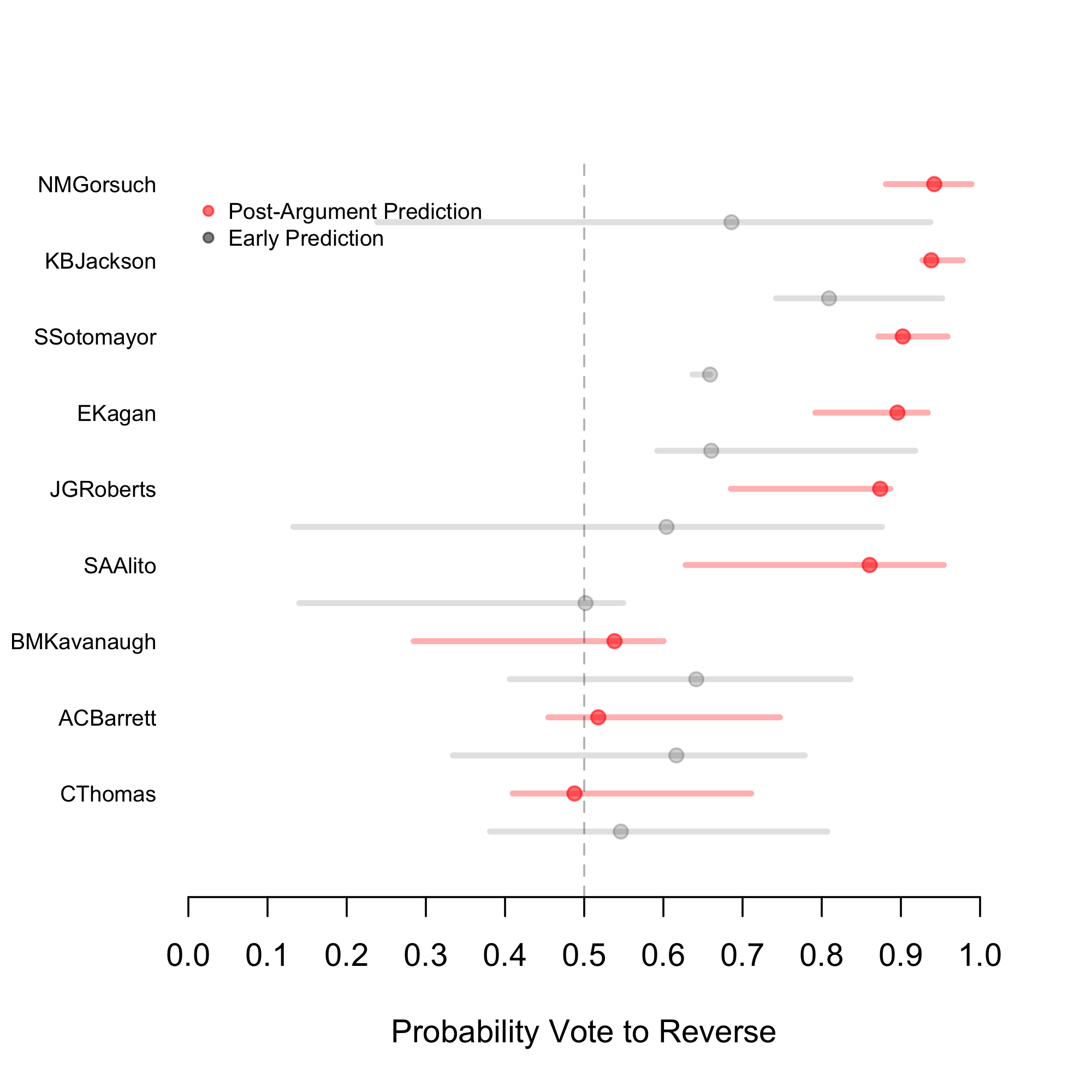
The model predicts strongly predicts a reversal—so the tolling doctrine would not apply to supervised release. Most likely dissents: Thomas, Barrett, Kavanaugh.
Vote Predictions