In United States v. Hemani, the government is defending a 1968 statute (922(g)(3)) that makes it a federal felony for an “unlawful user of or addicted to any controlled substance” to possess a firearm. During an FBI search of Ali Hemani’s family home, agents found a gun alongside roughly sixty grams of marijuana and a little cocaine. Hemani voluntarily pointed the pistol out to agents and said he used marijuana several times a week; the government ultimately charged him with possessing a firearm on the marijuana predicate. The question is whether that prohibition, as applied to Hemani, survives the Second Amendment framework the Court has built over the past few years in Bruen and Rahimi.
The Fifth Circuit affirmed dismissal of the indictment. That circuit reads Bruen’s history-and-tradition test to demand a close founding-era analogue for disarming non-dangerous recreational users, and held the firearm law unconstitutional as applied. During argument, the government did its best to say this was a temporary regulation of firearms for individuals, and that it had analogs in the early republic. Several justices seemed skeptical, with Barrett for instance asking if misuse of Ambien would be covered by the law (the government said, yes).
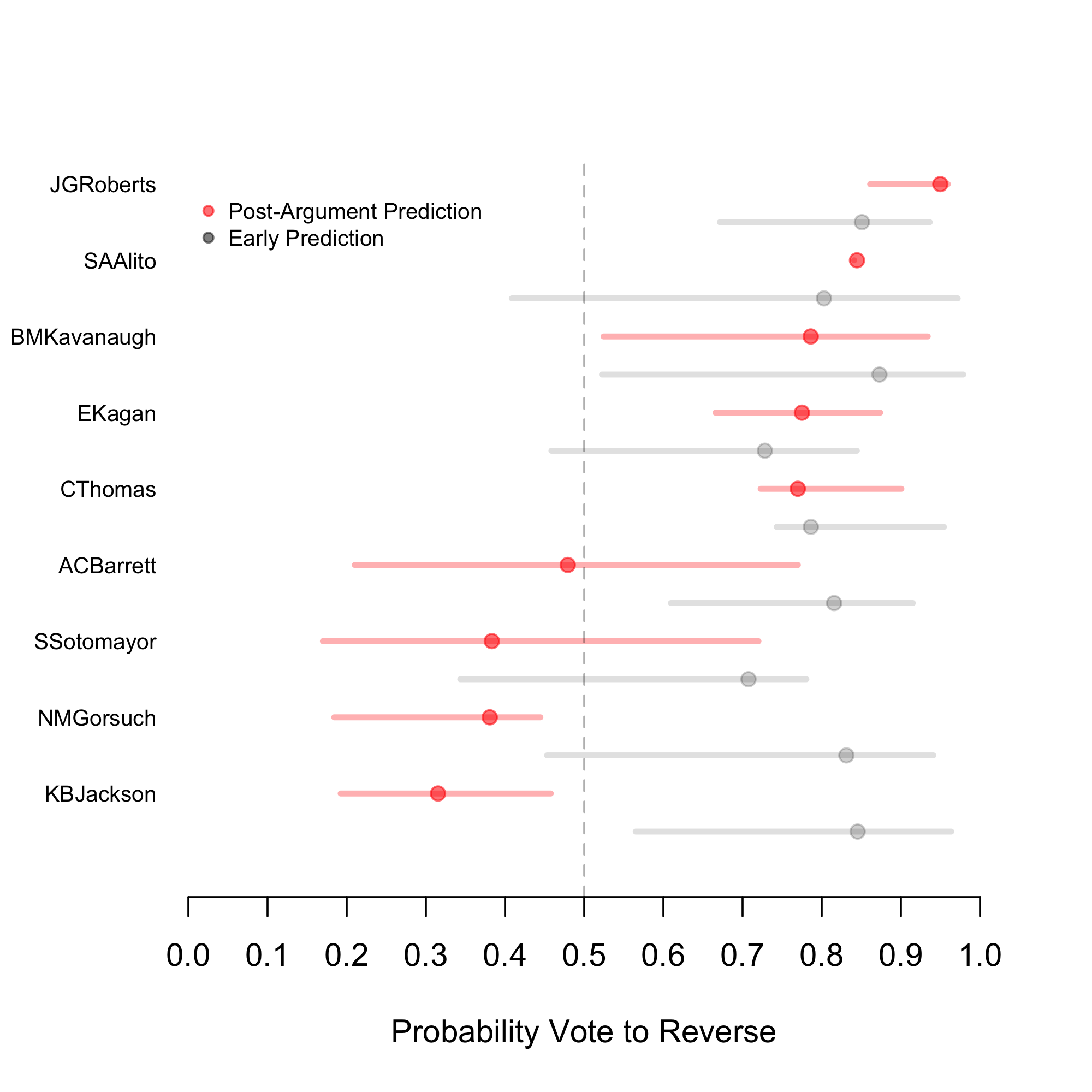
Most observers seem to think the Court will affirm the Fifth Circuit. The model, however, believes the Court will reverse in a coalition led by Alito and Roberts. This case pits concern about the Second Amendment against law-and-order concerns, which may plausibly split typical coalitions.
vote predictions