Sun Valley is an interesting and potentially important case, dealing with one of the most confusing and inconsistent areas in administrative law—that of “public rights.” At the risk of inducing PTSD in any of my students who might be reading this, a little background is necessary. The underlying question in this doctrine is when Congress may delegate adjudicatory functions to non-Article III courts. A distinction is whether the dispute is one of “private” or “public” rights. The Court has not been consistent either in drawing the boundary between private and public rights, or in the consequences that follow from falling on one side or the other of that boundary. Hence, the confusion.
Of late, the basic position of the Court is that if the dispute bears a strong familial resemblance to a suit at common law, then the dispute concerns private rights, and Congress cannot delegate the matter to a non-Article III court. Most recently, in a related context, the Court seemed to focus especially on the nature of the remedies sought—whether they resemble common law remedies—to assess the private/public rights line.
This case sits at the intersection of what—the current Court—would classify as private and public rights. It involves the H-2A program, which allow employers to import foreign workers, often subject to certain wage and work-condition requirements. Here, the Department of Labor (DOL) set conditions related to wages, access to kitchen facilities, and housing, among others. A DOL investigation into Sun Valley found that they had violated many of those conditions. The DOL assessed for back wages, and imposed financial penalties for the various condition violations, conclusions affirmed by an Administrative Law Judge (ALJ), and by an appellate body in the agency.
Now Sun Valley argues that the constitution bars the DOL from adjudicating this dispute. They argue that this is, in essence, a contract dispute, and therefore a dispute involving private rights. They highlight the financial penalties imposed on them. The Third Circuit agreed with Sun Valley. The government argues this is, in essence, an immigration case, a conventional area of public rights. The facts of the case therefore combine aspects of (what the current Court would regard as) private rights and public rights.
The central question of the case, then, is whether this is a contract or immigration dispute. In a meaningful sense, it is both. Going for Sun Valley, on the surface, this dispute is about fulfillment of contract-like conditions, the remedies resemble common law remedies, and the immigrant is not even a party to the dispute. But immigration, of course, drives the entire setup to the case. The adjudicatory scheme governs the conditional right of employers to use foreign guestworkers, and viewed in that light this appears squarely a public rights case. If the conditions reached outside the guest worker program, or originated outside of the program, in my view that would be different—that would be closer to earlier cases that wandered into private rights, where for example federal bankruptcy proceedings inhaled separate common law tort or contract disputes. But the conditions here originate in and speak squarely to the guestworker program.
The case is significant for law and policy. Legally, it is possible that the Court will give us clearer guidance on public rights, a long-standing area of confusion. It seems possible they will narrow the scope of public rights. The guestworker program in this case issues hundreds of thousands of visas every year, and the work conditions imposed on employers will be more costly and difficult to enforce absent agency adjudications. That means the conditions become softer in substance or effect; or the agency and Congress could re-envision the program, perhaps around employer licenses that turn on similar conditions. A revision of our understanding of public rights would, in any event, feed back to policy effect and design.
One other substantive note before predictions. The seminal case in this area, Crowell v. Benson, was not cited in either the petitioner’s or respondent’s principal merits briefs. Recent public rights cases involve the majority basically ignoring that case, which has a more permissive view of non-Article III adjudication than the current Court, over the cries of the dissent. So it is not shocking that the parties did not rely on the case. But the case is typically taken as foundational, and it is notable that it did not figure in the briefing. This suggests that recent majorities have successfully consolidated beliefs around the common law conception of public rights, so that it is not worth the word count to argue on Crowell’s terms.
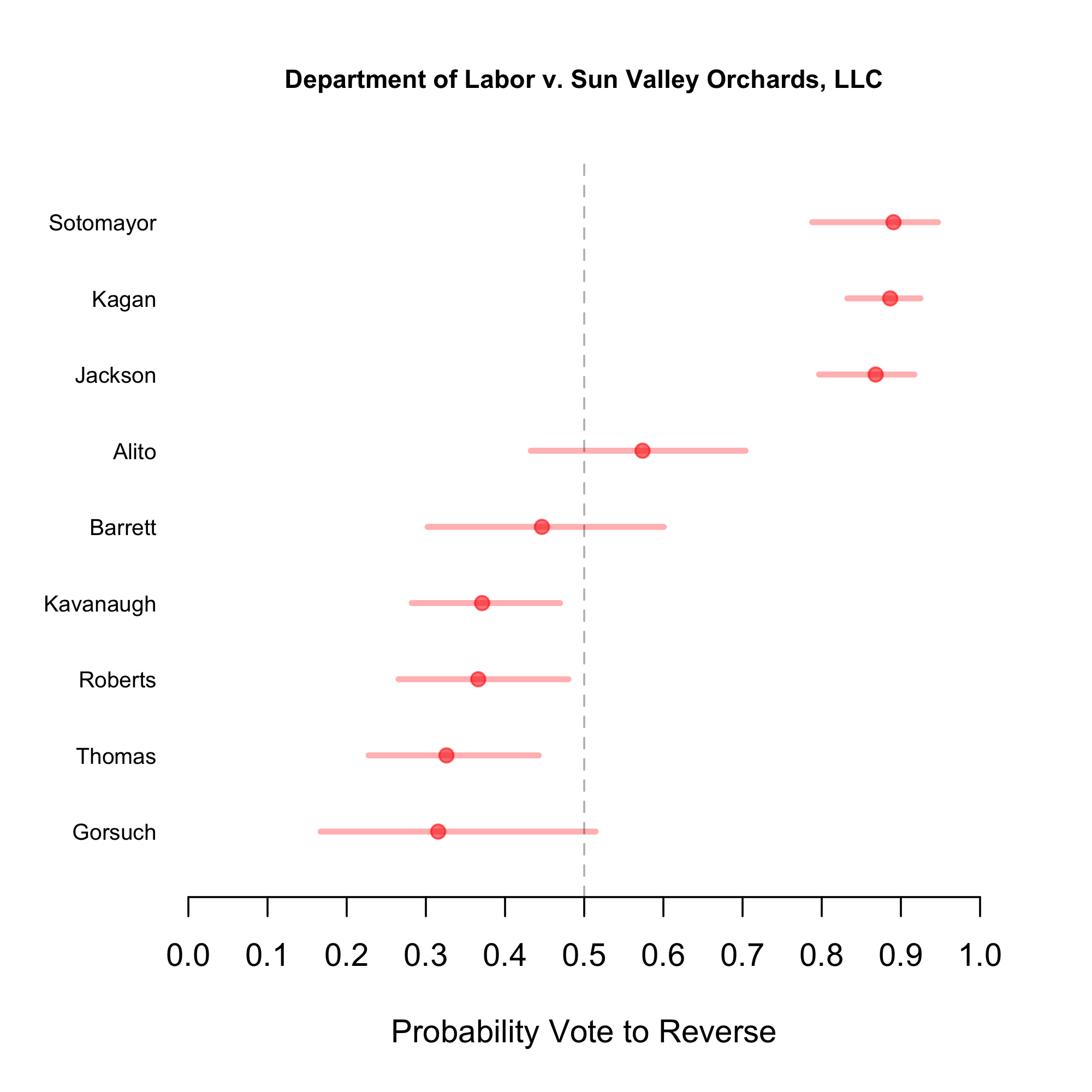
As for the predictions, the model’s best guess is that Gorsuch, Thomas, Roberts, Kavanaugh, and Barrett vote to affirm. That means holding for Sun Valley, narrowing a conception of public rights. Also notable, the model sees Alito as more likely to reverse than affirm, if just. That is a little surprising, but he did resist Sun Valley’s lines during oral argument, at one point suggesting they were asking for the Court to write a “hodgepodge” opinion. The model predicts the three liberals will vote to reverse. On the whole, the model sides with the liberals, slightly. Though five justices are more likely to affirm than reverse, their votes are relatively marginal, with uncertainty; Alito is on the fence; and the three liberals are obvious reverse votes. Added up, there is a decent chance of reversal—53 percent, though with uncertainty bands covering affirm [0.48, 0.59].
vote predictions